ONLINE & IN-PERSON CONTINUING EDUCATION FOR PROVIDERS
A new way forward for continuing education
We want to provide the best learning experience possible. To do this we are providing you with access to our online training course whenever you register for in-person training. View the in-person session as training to help you with the material in the online course. You will receive the pre-recorded online course within 3 weeks of the in-person course. If you wish for earlier access please email at greglehmanphysio@gmail.com
Remember, if you purchase the online training you get to use that purchase as a FULL CREDIT towards the in-person training provided Greg Lehman is the primary host for the course.
Click here to be taken to our Online Course Options (RBPS and Running Resiliency)
Available courses
Reconciling Biomechanics with Pain Science - In Person
This 2-day course is geared toward the health care provider and fitness professional. With emerging research there is often the feeling that a traditional approach needs to be wholly discarded. Instead, this course helps the therapist to integrate the pain science and biopsychosocial model of pain with traditional biomechanical techniques. The course simplifies many of those techniques and distills the most relevant and important aspects of those techniques for pain resolution and injury management. An emphasis is placed on exercise prescription, symptom modification and graded exposure for injury management and simple techniques to start addressing the psychosocial aspects that influence both pain and performance.
You will learn how "pain science" can be taught to patients in a way that builds resilience, optimism and promotes healthy and independent behaviours.
Course information here
The course outline can be found here
Online Training - Reconciling Biomechanics with Pain Science
This 13.5 hour online course is can be used as stand alone training or can be used as back-up reference material for our 1 or 2 day in-person course.
When you buy the online course you get to use that cost as a 100% full credit towards in-person courses organized by Greg Lehman. If you aren’t sure email greglehmanphysio@gmail.com
Running Resiliency - Online & In Person
Running Resiliency (Online Course is here) is a thorough and extremely practical best-practice management course for the injured runner. The course emphasis is on the manipulation of load and stress management in our injured patients and integrates running biomechanical principles within the biopsychosocial framework. We recognize that runners are ecosystems and ecosystems are positively and negatively influenced by a number of factors. Meaning we have multiple options to help our athletes. While not all of these options are taught we recognize that clinicians will have different skillsets and many of these skillsets will fit into the framework presented in this training.
Participants will be comfortable performing a thorough analyses of all the factors contributing to stressors on a runner, gait analyses (with potential modifications), return to run programs, running training programs and exercise prescription for both performance and injury management. Participants will be comfortable changing an injured runner’s training program to keep them running and will gain proficiency in designing training programs that also function as rehabilitation programs.
In Person Training Schedule for Reconciling Biomechanics with Pain Science & Running Resiliency
ARTICLES

We have a new clinical care standard for the management of knee OA (link here). It’s something that is fully consistent with how I practice and what I teach. It couldn’t be more bias confirming and I should not be happier.

I just put out a Movement Optimism Podcast on whether Physios suck at exercise prescription. It is in response to a trend over the past few years where I hear physios/rehab pros being criticized. The criticism is that Physios don’t understand the basics of Strength and Conditioning and that if they knew these better they would get better results with their patients.

Is Movement Optimism for Movement Morons?
This is a good question – a tad insulting but lets let it slide. Because we should challenge Movement Optimism. But first we need to look at what Movement Optimism is (good old blog here).
WARNING
I’m not sure you want to go down this road with me dear reader so consider this your warning. There are some messy potentially uncomfortable truths in this blog.

As someone who has literally been reading research for 30 years this is an odd opinion to hold. I love reading research papers. I’ve been a nerd for a long time. But…I think the pressure put on working clinicians to stay “up to date” is for the most part totally over cooked.

You click bait jerk. I know. But hear me out.
Apologies for the length of the post. It was meant to be a microblog but it morphed into pre-course reading for those taking Reconciling Biomechanics with Pain Science.
I know many people hate the term non-specific low back pain. The assumption being that if you know the anatomical source of pain you can give tailored treatment to your patients. But not only do I think that doesn’t matter much in the spine (there are exceptions and I wrote about that here) but it also doesn’t matter much at other joints. Let’s talk about the knee for example.
Clinical experts often hold strong opinions about the interventions they champion. They have no doubt helped a lot of people and have also been involved in research that supports their opinions. I want to listen to these people and learn from them.

Why this blog: This is a bit of thought experiment. Bear with me.
ASSUMPTIONS ABOUT PAIN, INJURY AND RUN TRAINING
Tissue injury/failure is considered to be a cause of running related injuries and pain. It is assumed that building tissue strength will decrease our injury risk. Hence, we say things like injuries occur when Load exceeds Capacity. Yes, there are issues with the term Capacity but that’s another blog

Traditional physiotherapy has often looked to find “deficits” in someones function and then suggested those deficits are what is causing pain. Deficits are typically any type of physical functions or attributes that deviate from averages. Typical examples being altered postures when you are standing that deviate from neutral (e.g your head might be forward, your pelvis might be tilted more anteriorly than average, some muscle is weak or range of motion is less than average).
This is going to be a three part blog. The first two parts will explore the reasoning why stiffness/tightness is often irrelevant for pain. The last blog will discuss times where stiffness and mobility might be relevant for pain and injury.
Part 1: Why you can stop worrying about stiffness
Muscle and joint tightness can be viewed as two things:

As someone with persistent pain (and a few traits that predispose me to pain) and a therapist for 20 years I am a proponent of resuming meaningful activities and exercise even when its painful…sometimes. I think that for a lot of people with persistent pain it is not only safe but its actually the thing that could help them most with recovery.

Confused? My apologies. Ten years ago I wrote a blog post (here) saying that foam rolling can’t stretch (i.e permanently deform or lengthen) your ITB. I stand by it. Its not some dough that you can kneed into some new shape and you sure aren’t “breaking up adhesions.


Below you will see a picture from a 2007 handout I would give for talks about running injuries and stretching. I had been anti-stretching for at least a decade. At least, I was anti-people telling others they needed to stretch to prevent injuries. I’ve also written about it here, here and here. It never made sense to me (it still doesn’t) so I enjoyed saying that the research at the time didn’t support stretching as an injury prevention method (again, it still doesn’t in runners)

Part 1: Running is Rehab: why running is part of the “fixing”
In Lehman’s Terms: When you are injured a primary component of recovery should be the activity you love.
It can be that simple some time. Running is one of the stressors that catalyzes your healing and your preparation to return to full time running.
From my extremely unscientific observation it appears that 67-74% of my patients have been told their glutes are inhibited. It seems to be an epidemic. I had to cancel my Runner's World subscription because the onslaught of glute inhibition articles was too depressing.

he Kinesiopathological Model or the “Movement Quality” model might be viewed as the opposite of the biopsychosocial model of pain and injury. But I would say like most debates this ends up being a false dichotomy. I’m of the opinion that most agree that the biopsychosocial (BPS) model is relevant for pain and injury AND most therapists would also agree that biology/biomechanics are sometimes relevant for people in pain. But the true debate might fall into two related areas where people will fall somewhere on a spectrum:

Non specific low back pain is often a diagnosis that clinicians might feel sheepish about. As if they have failed. As if acknowledging uncertainty is a bad thing that leads to bad care. This isn’t true. It is quite often the only appropriate diagnosis and is the one that is the most accurate. Other acceptable diagnoses are non-specific shoulder pain. Or non-specific knee pain. Because when we say NSLBP we are acknowledging that NO ONE knows the specific anatomical source of nociception/pain. This is not really a debatable issue

've been triggered. I guess I'm delicate. It seems like I can't exist without being covered in the bullshit of physiotherapy, personal training and chiropractic musings on pain and injury.
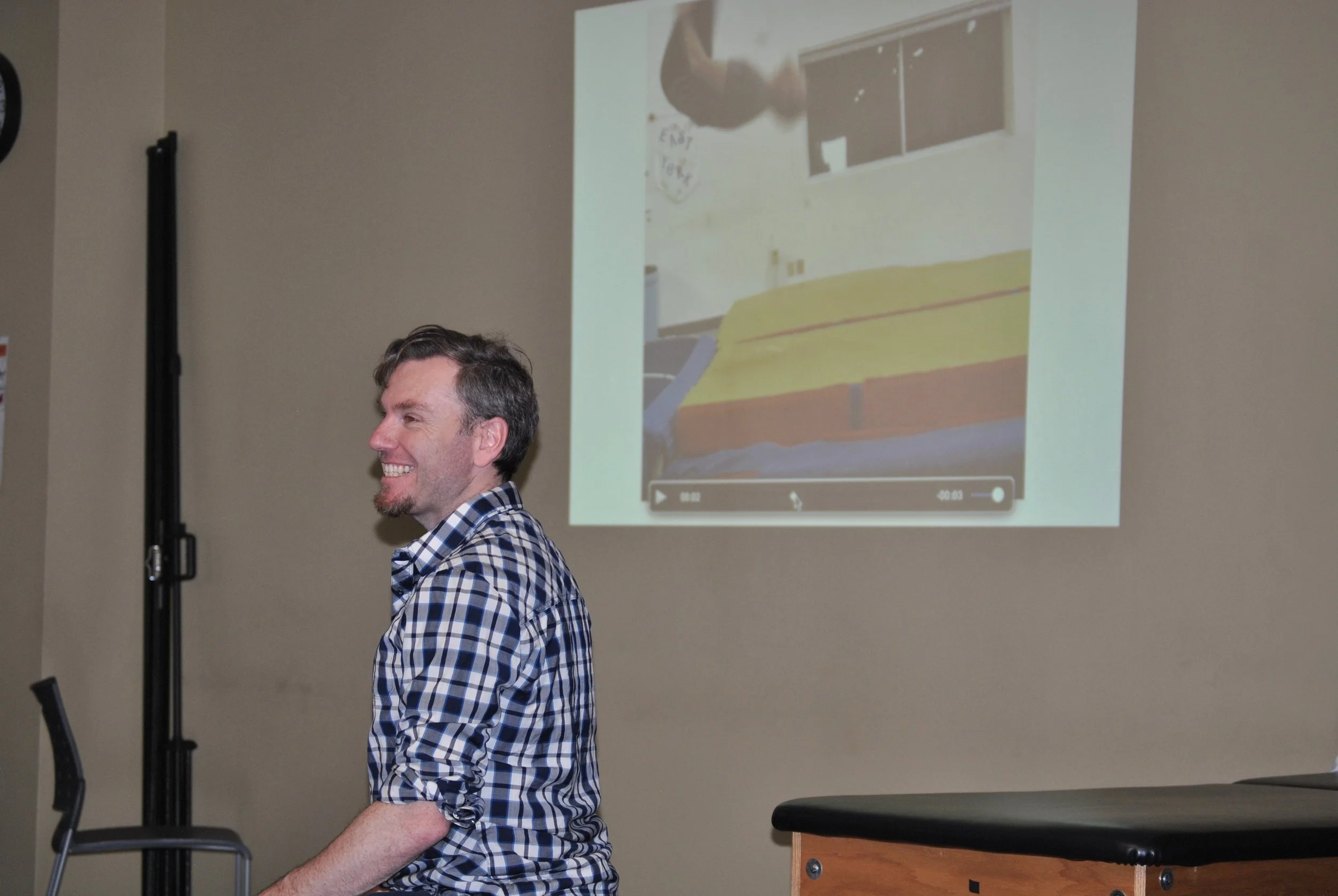
Audience: Therapists and people in pain
Blog Style: Lots of questions to consider
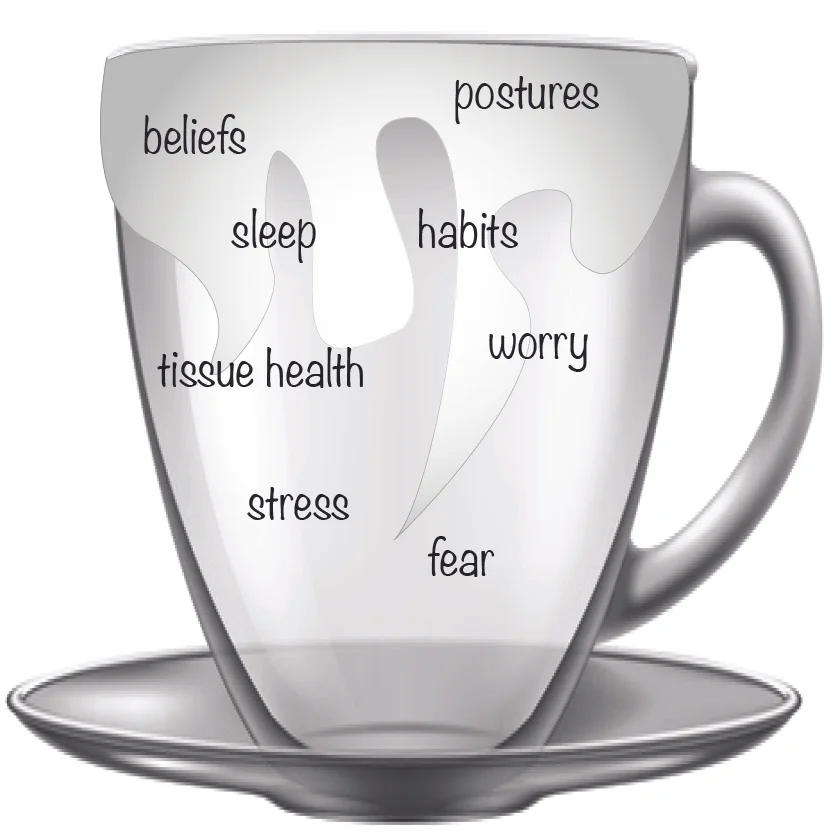
To help me understand pain and injuries and to hopefully help people I need to simplify things. One of the simplest ways to view pain is with the cup metaphor. It certainly has flaws but it does help look at the "big picture" of treatment. The cup metaphor suggests that pain occurs when all of the stressors/loads in our lives exceed the space in our cup. When we overflow we have pain


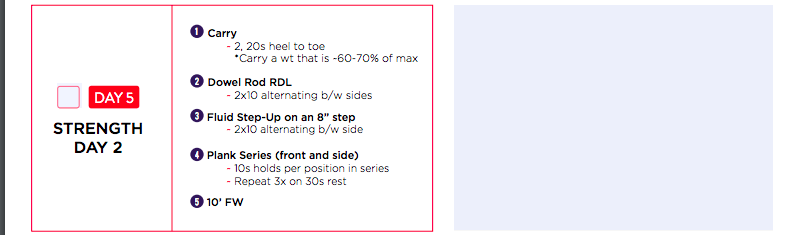
Well, look at this. My good friends Chris Johnson (he of famous mute exercise videos) and Ryan Debell (he of the superb MovementFix series) have created running and strength and conditioning programs. I'm being a total shill here because I am biased towards these guys
I am a biopsychosocialist.
I believe that biomechanics often matter for those in pain.
These two statements do not conflict.
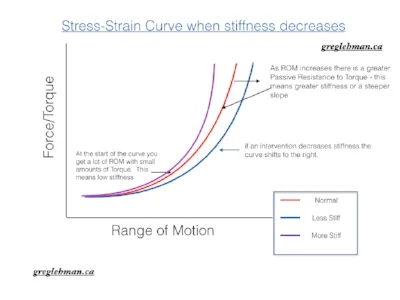
was informed of a recent post in The Huffington Post entitled "Stop stretching your hamstrings". This style of article (where we lambast some exercise) has been pretty popular for a number of years and I have certainly contributed my share. This one in particular I could have written 20 years ago when I was pretty strongly against yoga and stretching. I'd go out of my way to find any research that supported my bias.
Structure is not Destiny...but it still might be important.
We know that degenerative changes can exist on a spinal MRI and people can have no pain. Those changes aren't sufficient for pain
BUT
they aren't completely irrelevant.






A comprehensive approach to using a traditional biomechanically based practice within a biopsychosocial approach.